Sunday, November 27, 2011

Three Pinoy kids make a splash at the World Robot Olympiad

By Sheila Ramos
Philippine Daily Inquirer


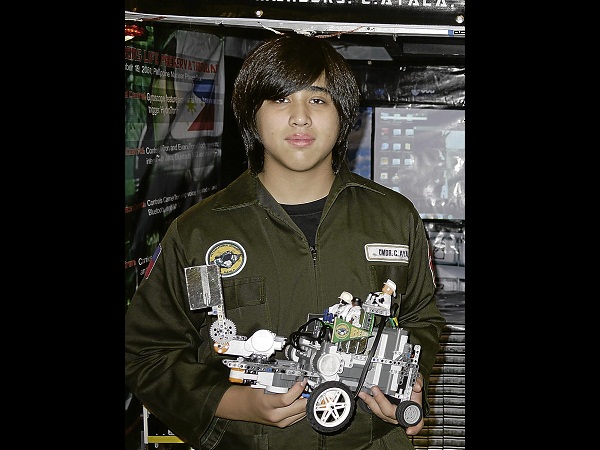
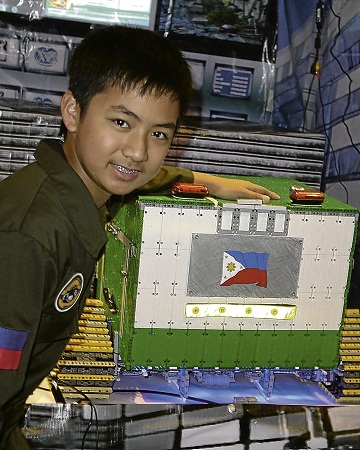
From Nov. 18 to 20, three teenage boys aspiring to be robotics engineers trekked to Abu Dhabi to compete in the World Robot Olympiad (WRO). It was a much-awaited trip for the boys, who put in hours upon hours of whatever spare time they had left after school, as well as on Saturdays and Sundays, in preparation for the competition.

All that hard work paid off as teammates Lucas Ramos, Cristian Ayala and Rom Villarica had a truly unforgettable experience, bonding not only among themselves, but also with kindred spirits from around the world. Geeky as it may sound, they found themselves among peers who shared a passion for building Lego robots and for NXT programming.

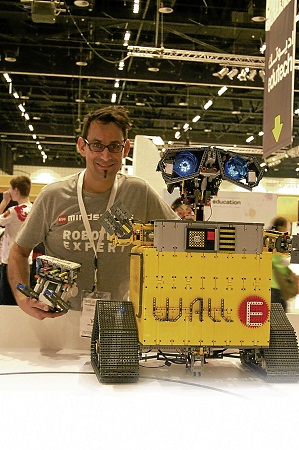
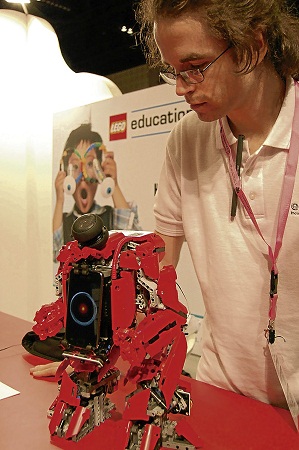
Much to their surprise, on their first day at the Abu Dhabi National Exhibitions Company (Adnec), Lucas, Cris and Rom were welcomed by the “rock stars” of the robotics world—Daniele Benedettelli and his Cyclops, Marc-Andre Bazergui and his Wall-E, David Gilday and Mike Dobson and their current Guinness World Record holder CubeStormer II, to name a few. All under one roof, face-to-face, with hands-on demonstrations of what their revered robotic inventions could do.
There was nothing more satisfying than seeing these students interact with their gurus, those truly credited for thinking out of the box and into the future, imagining a community where robots interacted with and assisted humans in daily functions.

Rock stars

Benedettelli is a world-famous young Italian robotics engineer. His robots have been viewed more than three million times on his YouTube videos. He has written two best-selling books, which feature full building instructions of his robots. He is the first to build the Rubik’s cube solver Rubik Utopia.

In WRO, Benedettelli showcased Cyclops, a complex robot that could walk and turn smoothly, gesticulate, talk, understand natural speech and interact with people by detecting faces and gestures. Truly, it was an honor for the boys that Benedettelli came and sat to watch Lucas, Cris and Rom present their robots.

And then there was Bazergui, a Canadian IT specialist who created one of the more popular robots featured in the WRO. His robot is inspired by and carries the same moniker as the well-loved animated robot Wall-E. Marc built a 20-cm tall Wall-E that transformed from a cube to its cinematic inspiration.

This Wall-E moved around on tracks, had flexible arms and a bobbing head that featured those popular blue telescopic eyes. Lucas and his robotics coach found Bazergui online earlier this year while brainstorming on what robots they could create for the WRO competition. With a robot carrier in mind, Bazergui guided Lucas in creating the CarrierTron, simpler than Wall-E, but with its own unique functions.

Meeting and chatting with Bazergui made Lucas realize his love for building and figuring out how things moved. This certainly was the highlight of Lucas’ Abu Dhabi adventure, as he found a future mentor. Throughout the competition, Lucas had in his pocket the two pieces of special Lego bricks Bazergui gave him.

Impressive work

Another impressive work of robotic art and a crowd favorite was CubeStormer II, created by Gilday and Dobson. Last 11-11-11, it set the Guinness World Record for the fastest time for a robot to solve a 3 x 3 x 3 Rubik’s cube, faster than the human world record. During demonstrations at the WRO, it consistently took around five seconds to solve the cube.

And, from robotic art to one robot that actually created art, Sacek’s 3D Milling Machines sculpted 3D faces and shapes with excellent precision. Such fine pieces created out of flower foam took one to two hours to create. Arthur’s machines milled different shapes over the three days that we spent at Adnec.
The possibilities are endless for what robots can be created for, and what these robotic inventions can, in turn, create. There was no better venue to be introduced to all these than at a Robot Olympiad where the minds of close to 1,500 finalists, selected from 15,000 teams from 38 countries, came together to exchange ideas and feast over each other’s creations.

Oh yes, by the way, there was a competition—almost upstaged by the Robotics Rock stars! Definitely worthy of mention is the fifth-place finish, out of 31 entries, of the team of Lucas, Cris and Rom, in the Junior High School Open Category that they competed in.

The highlight of the WRO for Cris was how the five-minute presentation of their robots to the judges was executed nearly flawlessly. Their teamwork and delivery were excellent. The buildup of pressure over the past eight months had been incredibly intense, starting in March when the boys started to plan and build their robots, increasing after they won the gold medal in the Philippine qualifying tilt in September, and intensifying upon their arrival at the gigantic Adnec to see the best robotics kids in the world, all busy getting ready for the big competition.

Global attractions
Though this competition was almost just an excuse to travel together and attend this convention, parents and brothers in tow, the boys were at the top of their game and came well-prepared. Fraser M. Smith, president of Raytheon Sarcos, dropped by to greet and watch the boys strut their stuff. It was Rom who was left in awe by this meeting, as Smith proved to him that one could be both a “hands-on” person and the president of a company.

He spoke at length with the boys about Raytheon’s many projects, including a motion-controlled robot that could lift heavy objects with ease. More notable was how Raytheon had built many robots for attractions across the globe, such as the Bellagio fountains display in Las Vegas and the robots for the Jurassic Park and Pirates of the Caribbean theme rides.

Smith handed each of the boys a business card, and it impressed Rom that he was a PhD—something Rom also aspires to be.

Smith is overseeing the creation of human exoskeletons for the US military—the real-life Ironman! Working in Raytheon would certainly be a dream job for the boys.

As Lucas, Cris and Rom made their way back home to Manila, back to school and their day-to-day homework, they now carry with them nuggets of inspiration from their experience at the Robot Olympiad, and a realization that there is a world out there where robots and their creators can thrive side by side.

http://bit.ly/vacjkO

Wednesday, November 23, 2011

All public high schools to have Internet in 2012

By


Education Secretary Armin Luistro INQUIRER FILE PHOTO
All the public high schools in the country will be connected to the Internet by next year, as the Department of Education brings a private sector-led Internet literacy program into the mainstream.

It’s not enough that we merely continue building classrooms and toilets… The real revolution in education which has long-term effects can only be done through IT (information technology)” Education Secretary Armin Luistro told reporters after receiving the final report of the Gilas (Gearing up Internet Literacy and Access for Students) project in a ceremony at Dusit Thani hotel in Makati City.

About 300 representatives of the organizations and institutions that took part in the project gathered on Monday as the project was formally ended and was turned over to the DepEd.

Speaking at the ceremony, Jaime Augusto Zobel de Ayala, chairman and CEO of Ayala Corp. and co-chairman of the Gilas project, said some 4.4 million students in 3,306 public high schools throughout the country now had access to cyberspace.

The project also trained 13,538 teachers to be competent in Internet-assisted instruction.

Ayala recalled that before Gilas was launched in 2005, bringing computers and the Internet to the public schools was merely a “ proposition and a dream,” as only six percent of what was then 5,443 public schools were connected to the Internet.

“Today it is no longer simply a proposition, it is no longer just a dream. The dream has become reality for millions of our Filipino students,” Zobel said.

Luistro said the DepEd has allocated P1.8 billion in 2012 to complete the Internet connectivity in the public schools.

So far, 97 percent of all public high schools have computers and 68 percent have Internet access.

The three percent are still nonenergized. We have to bring solar panels first to their respective areas before we include them in the project,” Luistro said.

Gilas spent more than P635 million it received from government agencies, legislators, corporations and nonprofit organizations.

Ayala Foundation in the USA, now called PhilDev, raised $1.5 million from overseas Filipino workers and other project supporters.

“We felt the sustainability of the project was a DepEd concern, therefore, we were happy when we learned the DepEd would take the project,” said Victoria Garchitorena, president of Ayala Foundation Inc.

http://bit.ly/vNwb2A

Monday, November 21, 2011

DepEd to deploy ‘Virtual Campus’ tech tool

11/19/2011 | 05:45 PM

The Department of Education (DepEd) is employing the aid of technology to address the problem of the growing number students who cannot attend classes in traditional classrooms.


The department said it is rolling out Virtual Campus, a first of its kind in the country which makes ready-to-use content to make learning and teaching more convenient for both students and teachers.

According to the agency, the Virtual Campus is an online community, e-learning and communication platform that allows the collaborative learning and activity sharing.

“This is an online community of teachers, students, parents and experts connected together online and on mobile phones,” the DepEd said.

The department said the Association of Private School Administrators of Muntinlupa (APSAM) has already tapped this technology tool to strengthen its educational service in their area.

The DepEd said recent studies have shown that the literacy rate in the Philippines is quite high compared to other Asian countries. The country, it noted, has succeeded in expanding its education in quantitative terms.

“The increase, however, raises several questions especially with the quality of education in the country because even though the statistics in education is high, still the economic situation is not so good,” it said.

Meanwhile, data from the DepEd reported that the completion rate for elementary schools stood at 72.18 percent in school year 2009-2010 and 72.11 percent in school year 2010-2011.

Moreover, the completion rate for secondary schools stood at 73.74 percent in school year 2009-2010 and 74.67 percent in school year 2010-2011. — Newsbytes.ph

 http://bit.ly/v5LxZR

Monday, October 31, 2011

DepEd launches laptop for every pupil program

By INA HERNANDO-MALIPOT
December 6, 2010, 5:35pm
 
LUBANG, Occidental Mindoro, Philippines — Pupils in two public elementary schools here were introduced to the wonders of digital learning as the Department of Education (DepEd), in partnership with Education Kindling (eKindling), officially launched the One Laptop per Child (OLPC) Program Monday.

Education Secretary Armin Luistro graced the launching and lauded the program saying that this would indeed scale up the quality of education especially with the use of modern technology.

“I would like to tell our students to make the most of this and use this to dream for your future,” he said.

Luistro also encouraged local officials as well as the schools to work together and find creative means of addressing problems in the basic education sector.

Mr. Ryan Letada, eKindling executive director, said the OLPC is a worldwide project that aims to create educational opportunities for the poorest children of the world by providing each child with a rugged, low-cost, low-power, connected laptop with content and software designed for collaborative, joyful, self-empowered learning.

When children have access to this type of tool they get engaged in their own education. They learn, share, create, and collaborate. They become connected to each other, to the world and to a brighter future,” Letada explained.

This program, said OLPC Philippines Susan Abaya, is first of its kind in the Philippines and in South East Asia and seventh in the world. “If possible, we want to replicate this not only in the entire province of Mindoro but in the whole country.”

A total of 100 XOLaptops were deployed by eKindling, a Philippines-based nonprofit dedicated to creating meaningful learning experiences by bringing technology-based, educational innovations to children, classrooms and communities across the country.

The XO is considered a potent learning tool that is designed and built especially for children especially those living in some of the most remote areas such as in Lubang Island. The laptop is about the size of a small textbook and has built-in wireless, unique screen which makes it possible for the children to read even they go outdoors.

Through these extremely durable, brilliantly functional, energy-efficient, and fun laptops, 95 grade four pupils in Lubang Central School and Maligaya Elementary School were introduced to new and joyful ways learning using modern technology. Four units were given to the teachers and one to the technical support for maintenance.

According to eKindling Education Director Tessa Yuvienco, it is very important for children to experience the educational possibilities of digital learning. “We want to show how technologies can provide a meaningful, transformative, and connected education to the children of the Philippines,” she explained.

The XOLaptops that were given to the students during the pilot testing cost $ 228 or about P10,000 each. The recipients would be able to use it until they finish elementary school. “The students can bring the laptop in their homes and they can do their assignments and even share it with their siblings and parents,” added Letada.

The laptops already contain educational materials developed by eKindling. In the classrooms, educators and students are expected to use the XOlaptops to enhance their learning in English, Math, Science, and Makabayan. “In the course of the academic year, they will also be introduced to new concepts of digital learning that is anchored on 21st century learning methodologies and a contructivist learning philosophy,” Letada explained.

http://bit.ly/rXzwIM 
 

Monday, October 3, 2011

Mobile learning now possible with tablet

Saturday, 01 October 2011 16:42 Rizal Raoul Reyes / Correspondent 


DIWA Learning System, a leader in the education publishing industry, recently unveiled the Classroom in a Tablet mobile education system to address the growing need for more efficient ways of delivering content. 
 
Jose Maria Policarpio, executive editor of Diwa, said the company decided to pursue a mobile platform to enable their content to become more relevant to the times.

“So we have put together Genyo eLearning, eTextbooks, digital classroom magazines, and our online portal in one mobile device to give our schools, teachers, and students their personalized Classroom in a Tablet,” said Policarpio in a press statement.

The Classroom in a Tablet is Diwa’s response to the growing need for effective ways of delivering content. With the wireless fidelity (Wi-Fi)-ready Acer Iconia W500 tablet, teachers and students alike can access Diwa’s extensive array of multimedia, curriculum-based resources through touch browsing.

We’ve invested heavily in eLearning because as the Internet becomes more accessible and hardware becomes inexpensive, we want to make sure that quality content is delivered in an interesting and informative manner to learners,” explained Policarpio.

Through the program, Diwa is helping future-proof the current generation of learners by combining traditional resources such as the textbook with technology-driven educational materials.”

Genyo—the country’s first and only Web-based e-learning management system that contains learning objects, lesson plans, tutorials, activities and exercises for science, math, english, Filipino and araling panlipunan—is the core driver of the Classroom in a Tablet program.

Completing this mobile education package are e-textbooks, digital editions of Bato Balani and Salaguinto science classroom magazines, and the online portal Diwa Learning Town, a virtual library for teachers and students that hosts more lessons, teaching plans, reading materials, e-games, supplementary educational materials and more.

Policarpio said the Classroom in Tablet program is a leading-edge solution because it merges both traditional and new media in one portable PC tablet that can be carried in any place.

http://bit.ly/mobile-learning-now-possible-with-tablet

Monday, September 26, 2011

Skype eyes connecting 1M teachers in social network for education

09/22/2011 | 11:22 PM

Videoconferencing giant Skype aims to connect one million teachers by building a social network for educators.

Skype said its "Skype in the Classroom" has so far signed up more than 16,000 teachers to its social network since launching a beta version in December.

“Skype has been going on for many, many years, and teachers have been finding each other and they’ve been finding ways to use the power of Skype in the educational process for a long time. We really felt that it was time to take this to the next level... moving from grassroots Skype in the classroom to an initiative driven by Skype," said Skype CEO Tony Bates on Wednesday at the Social Good Summit, according to a report on Mashable.com.

Bates announced the one-million classroom goal on stage after using Skype to video call a sixth grade class in New Jersey.

“If Skype can have 170 million connected users in eight years, can’t we have 1 million connected classrooms?" he said.

A free community

The "Skype in the Classroom" is a free community that allows teachers to collaborate on projects and discover new teaching inspiration.

It is a "global initiative" in response to the growing number of teachers using Skype in their classrooms.

With the platform, teachers can create profiles that describe their classes and teaching interests, and search a directory of teachers from all over the world by student age range, language and subject.

Mashable said what looms as a most useful feature is a “project" tab that helps teachers find partner classrooms for projects and ideas.

"One teacher, for instance, used the platform to coordinate a 'weather around the world' unit. A middle school in Massachusetts regularly chats with an Afghan youth peace volunteer group. Another was able to host a virtual visit from Barbara Bush," it said.

About 900 similar projects have been posted on Skype in the Classroom so far, the Mashable report said.

“It doesn’t have to be a famous person. A busy parent could share their skills from their office in the middle of the day," Bates said.

Additional improvements

Skype on Wednesday announced additional improvements to the platform, including email notifications for projects, a Skype in the Classroom “badge" that can be displayed on a blog, an “I’d like to do this" button on projects that adds the teacher’s avatar to the project page, and an “I’ve done this" button for leaving feedback.

It is also working on some of the suggestions raised at a recent virtual panel with five teachers, such as a Skype in the Classroom widget. ELR/VS, GMA News.

http://www.gmanews.tv/story/233175/technology/skype-eyes-connecting-1m-teachers-in-social-network-for-education 

Wednesday, September 14, 2011

House bill filed for ‘CyberEd’ program

Published : Wednesday, September 14, 2011 00:00
Written by :

A lawmaker who used to operate Internet gambling in the country now wants to institutionalize the implementation of a cyber education program for elementary, high school, and college education in the country.

Negros Occidental representative Alfredo “Albee” Benitez has filed House Bill 4993 to address the deteriorating quality of education in the country by utilizing information and communications technology (ICT) as a tool for achieving higher standards of learning for the students.

Prior to becoming a member of Congress, Benitez headed of First Cagayan Leisure and Resort Corporation, the “master licensor” of “Internet gaming” at the Cagayan Special Economic Zone and Free Port (CSEZFP) in Sta. Ana, Cagayan.

Benitez’s bill, to be called as the “Cyber Education Act”, creates the Cyber Education Development and Management Corporation (CyberEd), which shall be the principal policy-making, planning, and coordinating entity in the implementation of government programs and action plans related to cyber education.

Benitez said the CyberEd Corp shall formulate a program for cyber education planning, research and development, and monitoring of activities in coordination with the Department of Science and Technology (DOST), Commission on Higher Education (CHEd) and the Technical Education and Skills Development Authority (Tesda).

Under the bill, a nationwide Internet network will be established to connect the 17 regional network nodes in the country.

This will provide a 100 percent Internet and intra-net connectivity to all public elementary, secondary schools and SUCs using up-to-date ICT,” Benitez said.

Benitez said the Digital School Project will be established to provide all public elementary, secondary schools, and SUCs nationwide with the necessary physical and ICT infrastructure for ICT-based teaching and learning.

The private and the public school teachers and school administrators shall have access to quality and affordable laptops which is in support of the current Laptop for Teachers (LT4T) program of the DepEd,” Benitez said.

Benitez said some 10 million laptops shall be distributed by the CyberEd for the next ten years after the approval of the bill.

http://www.manilatimes.net/index.php/technology/7232-house-bill-filed-for-cybered-program

Saturday, September 3, 2011

Website unveiled to track condition, facilities of PHL schools

08/24/2011 | 07:39 PM

The Department of Education (DepEd) and the Ateneo School of Government have launched the initial implementation of checkmyschool.org, a technology-based mechanism that helps citizens track the condition, services, and facilities in the country’s public schools.

By logging in to checkmyschool.org, the public can have access to information on a particular school’s budget, enrolment, teaching personnel, furniture, textbooks, classrooms, toilets, test performance and proficiency ratings, among others.

The site facilitates interaction and allows users to send comments, photos, videos and additional information. The public may use the information like an independent third-party monitor of government performance in providing education services.

According to DepEd secretary Armin Luistro, the initiative takes advantage of information and communication technology to promote transparency and social accountability in public sector governance.

“Because it allows the public to send feedback on a particular school condition, it brings education-related concerns into the bigger arena of public scrutiny and appreciation," said Luistro.

The pilot implementation of checkmyschool.org, which runs from August 22 to September 2, 2011, involves volunteer orientation, validation of information on available school services, reporting and closing.

The pilot sites are National Capital Region, Pampanga, Pangasinan, Rizal, baguio, Benguet, Tacloban City, Leyte, Zamboanga City, Pagadian City, Cebu City, Iloilo, Davao City and North Cotabato.

Checkmyschool.org is a joint undertaking of DepEd and the Affiliated Network for Social Accountability in East Asia and the Pacific where the Ateneo School of Government serves as secretariat.

“Through this information-sharing project, we hope to enjoin the public and the private sector to contribute in closing education resource gaps that continue to hound our public schools. At the same time, it will give us feedback on how we can give better service to our stakeholders," Luistro explained.

Preliminary information in the website came from the different units of DepEd such as the Basic Education Information System, Physical Facilities and Schools Engineering Division, Instructional Materials Council Secretariat, Procurement Service, National Education Testing and Research Center and the budget office.

Updates on school information will come from school administrators, volunteers, and organizations in each local school.

The public may give feedback in many ways. They can validate or invalidate the accuracy of reported services, express satisfaction or dissatisfaction, or suggest ways to improve performance or offer to assist the school.

“Direct feedback from citizens is always welcome because they reflect the immediate, on- the- ground needs of schools," Luistro added.

To date, some 8,000 of more than 44,000 public elementary and high schools nationwide are included in the initial run of checkmyschool.org. — Newsbytes.ph

Saturday, August 27, 2011

DepEd: Laguna students to get tablet computers

06/07/2011 | 08:51 PM

For this school year, students at some schools in Laguna province will have something even their counterparts in Metro Manila may envy: tablet computers.

Department of Education Undersecretary Tonisito Umali hinted Monday this may be the basis of a long-term DepEd program to replace heavy books with high-tech gadgets.

"Sa Laguna binibigyan nila ng tablet ang mga estudyante sa Laguna. Kausap natin si Gov. E.R. Ejercito, yan malaking bagay rin dahil makakatulong yan sa usaping kakulangan ng aklat," he said in an interview on dwIZ radio.

(In Laguna, some schools are getting tablets. Governor Emilio Ramon Ejercito III believes this will be a big deal for students because it will help address the lack of textbooks.)

However, Ejercito did not immediately say how many schools or students in Laguna will be using the tablet computers.

A feature article on the Laguna government website indicated the eRizal Tablet is to be distributed to schools on the 150th birth anniversary of national hero Dr. Jose Rizal, June 19.

"The eRizal Tablet provides an easier and a more interactive access of students to electronic textbook copies, and avoids them from bringing numerous and heavy ones," it said.

Provincial Administrator Leonardo Ragaza Jr. said this tool would sharpen Laguna’s competitiveness when it comes to education.

Meanwhile, Umali said the DepEd is considering developing online learning modules that can use such tablet computers.

"Plano ng DepEd ang pag-develop ng modules, i-upload sa Internet o i-download ng batang may tablet ... dapat pagisipang mabuti," he said.

(We have been considering developing online modules that will be uploaded to the Internet, to be downloaded by pupils with tablets. We have to thresh out the details.)

He added that this is part of the government's efforts to be "more innovative" in the field of education by using computers and the Internet.

"Nagiging innovative lang tayo, sa computer at Internet, using it as a tool for learning and teaching (We have to be innovative. We can use the computer and Internet as a tool for learning and teaching)," he said. — TJD, GMA News

DepEd: Public-private partnerships key to ICT education

JM TUAZON, GMA News
07/13/2011 | 03:30 PM

Engaging the private sector in bringing technology tools to public schools in the country is a key ingredient in the Department of Education's (DepEd) push for information and communications technology (ICT) in education in the country, a ranking official said on Wednesday.

Speaking to the press at the sidelines of the 2nd Asia Pacific Ministerial Forum on ICT Education, DepEd Sec. Armin Luistro said that the government alone cannot address current education challenges, such as the need to impart 21st-century skills to students.

Luistro said that, with the help of the private sector, they were able to make great strides in bringing ICT to schools.

"One of our major achievements this year is that we were able to connect all 7,000 public high schools in the country, except for those without power and mobile connectivity," Luistro said.

"[In these endeavors], you need innovation and Public-Private Partnership (PPP) to get the projects moving," he added.

Luistro shared that GILAS (Gearing up Internet Literacy and Access for Students) —a collaboration among several Philippine corporations aiming to connect public schools in the country to the Internet— provided funding for connecting about half of all the public high schools to the Internet.

"Many of the initiatives applying ICT in education in the Philippines were made possible through this productive partnership between the private companies and the public school system," Luistro said during his keynote speech at the forum.

Bridging gaps

The DepEd chief was aware, however, that there are more pressing problems in the education system that needs to be addressed by the government, such as the lack of classrooms and textbooks in schools.

"Indeed, there are no quick and easy answers to the concerns that we face. These concerns, however, should not be addressed by piecemeal solutions, but through a comprehensive package of interventions," he stressed.

Despite the progress they have achieved with their ICT initiatives, Luistro said their efforts still fall short of equipping students with 21st-century skills.

"[But] our most viable option [right now] is to seize the moment and institute the necessary reforms to equip our learners with the necessary competencies for the future," he said.

For the time being, and until such time that ICT implementation in the education system has gone full swing, Luistro said the most useful application of technology in education is the linkage of students and teachers to their peers in other localities, as well as to hard-to-find resources.

He cited the Learning Resources Management and Development System co-developed by the agency and the Australian Government Overseas Aid Program (AusAID), which sought to make learning resources available to teachers.

"We are in the process of expanding access to this portal as well as populating it with more resources developed both internally and outside the Department," he said.

Assessing progress

But how effective are these projects, really?

Dr. Gwang-Jo Kim, director of the UNESCO office in Bangkok and co-chairman of the two-day Manila forum, stressed the need for a standard assessment system in evaluating ICT in education.

"We found that, except for a few cases, evaluation endeavors [in some countries] are not fully supported by budgets, and do not focus on outcome," Kim told the audience at the forum, composed mainly of education ministers in the region.

Kim said that even if countries do focus on outcome in their evaluation of projects, "student learning is not the primary evaluation objective."

He cited a certain study in which students where given computing devices to aid in education, where the desired objective was not met.

"What's troublesome, [the study said], is that when it comes to the use of technology in schools, it does not make any difference in students' math scores," he said.

"But when students use technology at home, there's an improvement in the score."

Kim stressed that there is a need to measure or evaluate if ICT-supported learning is really happening through these projects.

"Are students using ICT for their learning or something else? We automatically assume that when we give devices, they will use it for learning. Is that the case?" he pointed out. — TJD, GMA News